Saturday, March 19, 2011
Salvador Gutierrez P7 Mar.14 - Mar. 18
This week in AP Psychology: we learned about psychological disorders. What I found fascinating was that poets, authors, artists, and musicians have a high rate of having a psychology disorder. I already have noticed that many legendary poets, authors, artists, and musicians had psychological disorders. For example: Joey Ramone, Johnny Cash, Ernest Hemingway, Vincent Van Gogh, Ian Curtis, Jackson Pollock, and Michael Jackson. Some already had the disorder and found a way to express themselves and what they are going through while others, in a way, gave themselves a disorder. For example, a struggling artist takes some marijuana and ends up painting something amazing. So he decides to smoke more and more marijuana and take other drugs to come up with another good painting. Eventually destroying himself because of all the marijuana and any other drugs consumed. I am still not sure why material from people with some sort of disorder tends to be good. Is it because we don’t know what they are going through? That they live in another world, and so the things they write/sing/draw about is something new to us. It is human nature to like new things. Or is it because of their disorder, they are able to see the world differently, in a certain manner that fascinates us. I am not saying you need to have a psychological disorder to be a good poet, author, musician, or artist. But it just so happens that some of the legendary poets, authors, musicians, and artists happened to have some sort of psychological disorder. Then again, what does it mean to have a disorder? What does it mean to be sane?


Saturday, March 12, 2011
Salvador Gutierrez P7 Mar. 07 - Mar. 12
This week in AP Psychology: we learned about the different kinds of societies and their sexual attitudes; restrictive, semi-restrictive, and permissive. I live in both restrictive and semi-restrictive societies. My Mom’s family are semi-restrictive and my Dad’s family are restrictive. And it is all due to their culture. My Dad’s family are Christians, devote Christians. And any sign or thought of premarital sex or extramarital sex is shunned upon and they will stop talking to you, for years and perhaps forever. They are the kind of Mexicans that live and breathe telenovelas. On the other hand, my Mom’s family live and breathe Mexican game shows. They are Catholic, (and I know this is a stereotype but it has some truth to it) so they are not truly devoted to the ten commandments. They do not mind premarital sex as long as no one gets pregnant, if there is a pregnancy they get angry but then they forgive and move on. When they find out if you have committed extramarital sex, they are also angry at first but then forgive and move on. From my experience, semi-restrictive is the way to go. Because there is more happiness, love, and family togetherness. Unlike my Dad’s family where sisters stop talking to each other and are never in the same building together. Also, a restrictive society just increases the chances of premarital and extramarital sex, because it is a form of rebellion. Oh, I forgot about the third society. A permissive society just sounds too disorganized. It reminds me of the hippies during the 1960s. I will raise my kids in a semi-restrictive society, like my Mom’s family. I will still tell them the consequences of premarital and extramarital sex and tell them that it is wrong, but if they still happen to do it then they will have to live with the consequences of their actions and I wont stop loving them.
Saturday, February 26, 2011
Salvador Gutierrez P7 Feb. 21 - Feb. 26
This week in AP Psychology: we learned about one of the best feelings in the world, eureka/insight solutions. It is when you suddenly come up with a solution for the certain problem you had. It happens on the third stage of creative problem solving. After incubation and before verification-elaboration. It’s kind of the same thing as the tip-of-the-tongue phenomenon. Where you can’t remember exactly what it is so you stop thinking about it (incubation) and after a while, you suddenly remember what it was. The eureka insights make you feel like a genius. WARNING: you must have a pen and paper with you always because you don’t want to forget your eureka solution. I have had many eureka solutions where I would forget what I came up with. All those creative ideas, those genius ideas and solutions that would have blown the world away…gone. Anyway, that’s my life motto now. To carry around a notebook and paper and to put everything aside because I will eventually get back to them with a better solution. Which is why for homework assignments, their shouldn't be a due date and the students should just put away their homework and forget about it. Once you have an insight solution, then you can do your homework and turn it in. It will increase the quality of homework turned in. If you don’t get an insight solution by the end of the year, then forget about it. Life goes on, brah! - “Ob-La-Di, Ob-La-Da” by The Beatles. I bet The Beatles wrote most of their songs through eureka insights. They would stop writing and then just go on with their lives. And suddenly, while reading a nursery rhyme to the prime minister, they would come up with the chorus. If we treated homework like The Beatles treated songs then we would turn in some #1 hits.
Saturday, February 5, 2011
Salvador Gutierrez P7 Jan. 31 - Feb. 04
This week in AP Psychology: we learned about observational learning and how you mostly learn from those who you admire. I have many examples of unconsciously behaving like others. I frown like Jim from “The Office” does. I smirk like Marlon Brando smirks. I cross my arms like Marlon Brando did in a poster for “A Streetcar Named Desire” (although I consciously started doing it, I unconsciously do it now). When I try to act tough and cool I begin to make a face like that of Marlon Brando. As I was telling my mom this the other day, she pointed out something interesting. She said that what if I already acted like that, smirked and behaved like Marlon Brando when trying to be cool. But my behavior modified slightly to that of Marlon Brando’s because we are similar rather than strictly because I admire him. Which is true in a way. I don’t admire Jim from “The Office,” but I relate to him and began to act a bit more like him. But then again, don’t you admire those who you relate to? Anyway, I am a bit self-conscious now. Trying to figure out where I learned this and that from. It seems that I only learn from movie actors/characters, but I also learn from my family. For example, I touch my moustache with my lower lip like how my grandpa does. I am also noticing how some of my behavior has rubbed off onto my brother. Like he also crosses his legs while leaning against something, like I do. Now that I think of it, observational learning is pretty much common sense. How else can you learn a certain behavior? You learn by other humans around you or be like Tarzan and learn by the apes around you.
Saturday, January 22, 2011
Salvador Gutierrez P7 Jan. 17-22
This week in AP Psychology: we learned about socio-cultural theories. It’s based on how culture, socio-economic status, birth order, school, peers, television, and parents shape your language. I agree with this very much. I don’t see any way possible how anyone can disagree with this theory. It explains how language is different according to the region and decade. Now that the world is “smaller,” there are even more differences among people and their languages. I speak English with a southern California accent because I live in southern California. And speak Spanish with a Michoacán accent because I spend more time with my mom and her side of the family rather than my dad’s side of the family, so I speak as if I was from Michoacán (mom) rather than Jalisco (dad). When I say Michoacán, I mean San Jose de Gracia because that’s where my mom’s from. When I say Jalisco, I mean Tepatitlan because that’s where my dad’s family is from. The words I use is from a mix of Los Angeles (where I live), skaters (friends), Mexican (family), British (extensive watch of Monty Python, The Office BBC, and Fawlty Towers), and Whitney (school). I am more aware of what I am saying now. I think about where I got that word from. This is a very useful tool that I should look into more. It will help me with dialogue when coming up with video ideas and writing scripts because I will have a better understanding of how the character should speak. Language is something that will never go away, it just grows and grows.
Saturday, January 8, 2011
Salvador Gutierrez P7 Jan. 03-08
This week in AP Psychology: I learned about sleep, hypnosis, and dreams. What I liked the most was the stuff on dreams. Dreams consist only of your past experiences and of what you already know. Last year, I began a sleep journal. I would go online to the dream dictionary and see what things meant. But it turns out that it all depends on your interpretation rather than someone else’s because it’s your dream and your thoughts and feelings. For example, a horse can mean freedom and stamina to someone but it can also mean grandfather to someone else.
After watching Inception, I began to try to have a lucid dream. I did all the tricks and no good. I wrote the letter “A” on both my palms, counted sheep (in order to keep counting once the dream starts and then I would realize I’m in a dream and then I can stop counting and have fun), and I would try to notice the little details that can give away that I’m in a dream (i.e. I’m reading a book and the letters would change every time I would look away, I’m in one location and then I would end up somewhere completely different just by going through the door). I didn’t continue the sleep journal that I mentioned earlier, but I will try to continue on this journal. I’m still not able to remember my dreams with the right amount of detail to figure out my unconscious, but I will soon. Remembering my dreams will help me in life because dreams are like simulations and they can teach you the best possible thing to do in certain situations.
After watching Inception, I began to try to have a lucid dream. I did all the tricks and no good. I wrote the letter “A” on both my palms, counted sheep (in order to keep counting once the dream starts and then I would realize I’m in a dream and then I can stop counting and have fun), and I would try to notice the little details that can give away that I’m in a dream (i.e. I’m reading a book and the letters would change every time I would look away, I’m in one location and then I would end up somewhere completely different just by going through the door). I didn’t continue the sleep journal that I mentioned earlier, but I will try to continue on this journal. I’m still not able to remember my dreams with the right amount of detail to figure out my unconscious, but I will soon. Remembering my dreams will help me in life because dreams are like simulations and they can teach you the best possible thing to do in certain situations.
Saturday, December 4, 2010
Salvador Gutierrez P7 Nov. 29 - Dec.04
This week in AP Psychology: we learned about the different parenting styles. I pay more attention to my parents trying to figure out which style they fall into. Both my parents are authoritative. But my mom is a bit more permissive towards me now that I am older. I am glad my parents are not Asian. I know not all Asians are authoritarian but most of them are. I have asked my Asian friends (Korean, Thailand, Taiwanese, Japanese, Chinese, Indian, and Bangladesh) what parenting style their parents are and most of them said authoritarian. A Korean friend of mine has authoritative parents but they are authoritarian on certain issues like school. I also know that not all Caucasian parents are permissive, but most of them are. I think I am going to be an authoritative parent when I have kids. It is the one style with the most benefits. I am also going to be authoritative since it is the only way I know how to parent. Everyone ends up to be like their parents because it is the only way they know how to parent. I think being authoritarian will make your children dislike you and take you for granted. And being permissive will make your children miserable because they do not have any guidance or fatherly figure to look up to. I think being permissive shows how little you love and care for your children. Every time I see a parent with his/her child, I try to figure out what kind of parent they are. I am a bit confused on how there are only 3 styles. There have got to be more.
Saturday, November 13, 2010
Salvador Gutierrez P7 Nov. 08-10
This (half) week in AP Psychology: we learned about sensation and perception. There are a few terms that I can relate my life to. For example, I constantly notice that my sensitivity decreases the more I am stimulated. I do not even notice anymore when my sister is talking, when my brother is whining and complaining, or the sirens from the police and fire men because I hear it so much. It also happens when I am listening to music. After a few minutes, I do not even notice that the music is still playing. As I was writing that, I remembered that the music was playing. I have even slept with the headphones still on (which is why I do not listen to music when I sleep anymore because I could seriously choke). A few years ago, the school nurse sent me to the doctor because she thought I was going deaf since I failed the hearing test about three times. But I did perfectly fine at the doctor. It must have been stimulus detection. I must have had a bunch of false alarms, thinking that there was a stimulus/beep. Perhaps because I was expecting a beep, I made myself believe that there was a beep.
I like this chapter, I can not wait to learn more about sensation and perception. It is something that we do every second of our lives. Every time I smell, touch, hear, taste, or see something I begin to interpret it, describe it, and record it in my noggin.
I like this chapter, I can not wait to learn more about sensation and perception. It is something that we do every second of our lives. Every time I smell, touch, hear, taste, or see something I begin to interpret it, describe it, and record it in my noggin.
Saturday, October 23, 2010
Salvador Gutierrez P7 Oct. 18-22
This week in AP Psychology: I learned about how genetics influence who you are. That genes determine most things about you. There are numerous methods to study this. There is the adoption studies, where adopted children compare themselves to their biological dad and to their other dad (the one who raised them). Twin studies is to compare fraternal twins to identical twins. Twin-adoption studies is to compare twins (fraternal and identical) who were separated at birth to those twins that were raised together. Gene-by-environment studies is to study whether genetic differences mix with the environment to make certain behaviors in some but not others. I believe that this is true, that genes are the primary factor in making you who you are. Because I see similarities between me and my parents, grandparents, and other family members instead of seeing similarities between me and the environment. Some argue that you are similar your parents and other family member because they taught you to be like that, but I believe that I inherited their traits and looks genetically. It has been proven. Identical twins who were separated at birth were almost completely similar in every way, even though they grew up in different environments. Many argue that the environment influences you, but I think you influence the environment. For example, I was born intelligent, so my parents encouraged me to do good in school. They did not encourage me to do good in school, and so then I became intelligent. They encouraged me because I was already intelligent. In conclusion, genetics determine who you are and influences the environment.
Saturday, October 16, 2010
Salvador Gutierrez P7 Oct. 11-15
This week in AP Psychology: we learned about mere exposure. Mere exposure means that the more direct exposure you have with something, the more you prefer it. This is in almost every single romantic comedy. The two characters have nothing in common, they are bad for each other in every way, and they are not attracted to each other in any way. They would spend time with each other and the audience laughs their butts off because the characters hate each other and they keep fighting with each other in a funny way, and there is the comedy. They begin to have certain feelings for each other after spending some time together, and there is the romance. This tends to happen to me with music. At first I don’t like the music, but after listening to it some more it would “grow on me.” The first time I heard Joy Division I did not like their music, but then I saw the movie “Control” and now I really really like Joy Division. That movie played their music a lot, enough to make me like it now. I think the reason we tend to like something after being exposed to it so much is because after a while, you begin to see the good qualities of the music, person, etc. The movie “Control” showed me the creation of the band, the struggles they faced, and how cool their music was. For example, they used a spray can for one of their songs. They recorded someone spraying the can and then they would play the recording during the song at the concerts. That is genius. Using a unique sound like a spray can. Another reason we tend to like something after being exposed to it so much is because we tend to like things we are familiar with. Someone may not like filing papers but they have to do it every day. After a year, they are asked if they want to do something else and they would most likely stay with filing papers because it’s what they know best.
Saturday, October 9, 2010
Salvador Gutierrez P7 Oct. 4-8
This week in AP Psychology: we learned about altruism. Altruism is selfless attitudes and behavior towards others. I believe that no one in this world is truly selfless. If you are completely truly selfless, you will die quickly. To survive in this world you have to think of yourself and care for yourself. When you’re in the middle of the desert with another person and you find an apple, you will have to think of yourself and take it instead of giving it to the other person or else you’ll die. We learned about the black man that saved a guy from being run over by the subway train. The black man’s act was not completely selfless. It was kin selection because he put his children first, selfishly. When he was asked why he saved the other man, he said that he did it because he did not want his daughters to see a man die. I would not like it if everyone was altruistic because selflessness would lose its meaning. In an episode of The Office, Dwight was being selfless and doing nice things to others (he would say, “You owe me,“ to everyone) and Andy would return the “selfless” kindness (for self-satisfaction). Dwight would open the door for Andy, Andy would let Dwight go first, Dwight would insist that Andy goes first, Andy would insist that Dwight goes first etc. It was annoying because they would not stop doing nice things to each other, it became a competition. So Andy and Dwight would selfishly compete against one another on who’s more selfless. They went from being selfless to selfish. Which proves my point that no one can be truly selfless. I honestly think that this whole thing on altruism and selflessness is a bit confusing and can be interpreted in many ways. I just live by this: treat people the way you want to be treated.
Saturday, October 2, 2010
Salvador Gutierrez P7 09/27-10/1
This week in AP Psychology, we learned about the Stanford prison experiment thingy. A couple of Stanford students participated in the experiment. They were told in advance that the experiment involved someone being a prison guard and another being a prisoner. Half of the students were assigned as the prison guards and the other half of students were assigned as the prisoners. The crazy thing is that the “prison guards” were really mean towards the “prisoners” and made them do humiliating things. The “prison guards” spent their ordinary days of their ordinary lives being kind, like always, but when they went back to the prison and put on the uniform, they were mean. They made the “prisoners” do pushups, act out scenarios like: Frankenstein hugging his wife, and many other things. The experiment was cut short because the students were really into their roles, the “prisoners” honestly believed they were real prisoners. The data from this experiment is that everyone has some evil in them and will show it under certain circumstances. This is very true. Take me for example. I am nice to everyone but I know for a fact that if I went to war, I would be somewhat evil towards the enemy. You also see this everyday, everyone will tease another person or talk bad about him/her behind his/her back. From now on, I’m going to be nice to everyone no matter what because I do not want them to become evil and be mean to me. It is like how Dane Cook said in that one joke about the weird guy in the office. That everyone would not talk with the weird guy, leave whenever he was present, and talk bad about him behind his back and spread rumors about him. But Dane Cook would give him a chocolate bar everyday. And the day came when the weird guy barged into the office and began shooting everyone, but he did not shoot Dane Cook. Instead, he thanks him for the chocolate.
Saturday, September 25, 2010
Salvador Gutierrez P7 Sep 20-24
This week we talked about horoscopes and if they are true or not. Honestly, I was really surprised that they were not true, but then I understood why. I believed in the zodiac signs since the descriptions of the horoscope seemed correct, but I did not realize that I also related to other horoscopes. For example, I am a Scorpio but I also have the same likes as the Cancer and the same dislikes as a Libra. Another reason why I understand why horoscopes aren’t true is because it makes no sense how depending on the month you are born in, that determines your personality. When your personality is determined by your parents‘ personalities. The only reason that people believe that the zodiac signs are true is because the descriptions of each sign are too vague, don’t go into too much depth about someone’s personality, they give simple traits that most people have in common: liking hobbies, children, disliking hunger, being taken advantage of, tyranny, etc. That way, there’s a higher chance that the person will relate to their horoscope. And the advice given to the horoscopes are the same as well, they give vague advice, common and simple advice that will; most likely help the person no matter what horoscope they are. And it also doesn’t make sense how we are assigned planets, rocks, and animals or some other symbol. People can go ahead and still follow the zodiac signs and read the horoscope articles in magazines, but they must realize that there is more to them than their very limited and vague horoscope.
Saturday, September 18, 2010
Reflection for 10/13 - 10/17
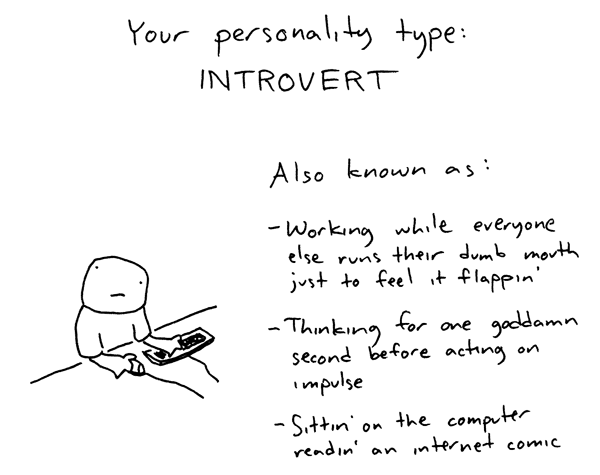
This week, we learned about the different sub disciplines in psychology. I was surprised on how many there were. There are quite a lot. There is a different sub discipline for every little thing. There’s psychology on sports, health, industry and organization, crime, disorders, personalities, education, the brain, the body, and thought. Out of all of them, I can’t wait until we learn more about personality psychology. I think personality psychology is very interesting. I have been going to personalitypage.com and been reading about all the different types of personalities. And I look at how each personality type treats their relationships and what kind of careers they will probably choose. Personality types can tell a lot about someone: their behavior, how they dress, their likes and dislikes. Also, knowing your own personality type can help you become a better person by overcoming your weaknesses and embracing your strengths. I saw what my weakness are and how to be a better person. And I must improve my extraverted sensing, but it’s difficult because I don’t fully understand Psychological Types and the little details of every personality type. I want to learn more about the other personality types so that I can begin to see the world objectively and have a well developed extraverted sensing. I am also excited to learn more about all the other sub disciplines of psychology. But personality types is more interesting, in my opinion.


Subscribe to:
Posts (Atom)